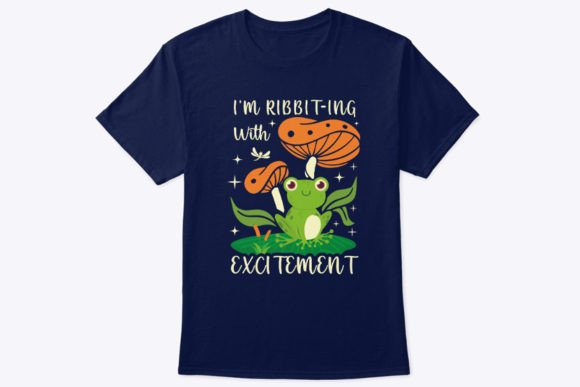
Frog Custom T-Shirt Design Graphics
As someone who’s launched over 200 digital product listings across Etsy, Creative Market, and Shopify—and scaled three print-on-demand collections—I opened Frog Custom T-Shirt Design expecting either a charming niche asset or a generic clipart repeat. What I found was refreshingly intentional: a clean, scalable frog illustration with balanced negative space, friendly proportions, and subtle personality—neither cartoonish nor overly stylized. It lands squarely in the “playful yet polished” zone—ideal for kids’ apparel, eco-conscious brands, nature-themed classrooms, and cottagecore-adjacent small businesses.
The mood is approachable and inclusive—“Frogs Are Awesome” isn’t just a slogan here; it’s baked into the design’s posture, rounded edges, and open expression. It reads well for girls, boys, and gender-neutral audiences without leaning on stereotypes. That versatility matters when you’re building bundles for seasonal launches—think spring classroom merch, Earth Day tumbler wraps, or backyard birthday party kits. It doesn’t scream “toddler only” or “science teacher only,” which expands its commercial lifespan.
This graphic design asset works hardest where flexibility meets clarity. As an SVG design, it cuts cleanly in Cricut Design Space and Silhouette Studio—no jagged edges or stray anchor points. As a PNG design, the transparent background holds up at 300dpi across printable planner stickers, greeting cards, and sublimation-ready mug designs. The vector EPS and PDF files scale effortlessly for large-format tote bag prints or nursery wall art—no pixelation, no reworking needed. And because it’s built with clean paths and minimal layers, it drops smoothly into Canva templates without distorting fonts or alignment.
I tested Frog Custom T-Shirt Design across six real product scenarios: a kids’ t-shirt listing on Etsy, a digital sticker pack on Creative Fabrica, a spring-themed Canva template bundle, a sublimation-ready tumbler wrap set, printable wall art for nurseries, and a social media graphics kit for eco-bloggers. In every case, it anchored the visual hierarchy—drawing attention without overwhelming supporting text or patterns. On mockups, it held strong against textured fabrics and matte finishes. As a thumbnail, it stood out in crowded search feeds thanks to its clear silhouette and contrast-friendly color range (works equally well in kelly green, navy, mustard, or soft sage).
Where this asset shines most is in product presentation. Used consistently across a collection—say, matching frog SVGs on t-shirts, mugs, and tote bags—it builds instant brand recognition. Paired with a friendly sans serif font (like Poppins or Quicksand) for product titles and a light script font for taglines, it supports cohesive small business branding without requiring custom typography. For Etsy sellers, that consistency boosts perceived value and encourages cross-selling. For print-on-demand sellers, it reduces customer service queries about sizing or cut lines—because the SVG design is production-ready.
It also strengthens trust. Buyers scanning digital download listings notice clean file organization—labeled EPS, SVG, PDF, and high-res PNGs—and that signals professionalism. When your customers unzip a folder and find a README with usage tips, color codes, and commercial license confirmation, they’re more likely to leave a five-star review and return for your next design bundle.
That said, Frog Custom T-Shirt Design isn’t universally plug-and-play. Avoid cramming it into tiny sticker sheets under 0.75 inches—the fine details in the eyes and toes lose definition. Skip using it as the sole element on dark backgrounds unless you’ve added a subtle white stroke or shadow (the base file has no outline). Don’t layer it densely with other illustrations in scrapbooking kits—its friendly weight gets lost. And if your Cricut project demands ultra-fine cut lines (like delicate lace overlays), test the SVG cut quality first—some vector exports retain unnecessary nodes that slow cutting.
Before publishing any listing featuring Frog Custom T-Shirt Design, run these five seller checks: First, drop it into at least two realistic mockups—one light garment, one dark—and screenshot how it renders at 50% size (simulating mobile thumbnails). Second, open the PNG in Photoshop or GIMP and verify full transparency—no hidden white pixels along edges. Third, import the SVG into Cricut Design Space and run a “simplify” test—if it collapses into one solid shape, the paths need cleaning. Fourth, print a physical swatch on your target fabric or paper stock to confirm color fidelity—especially if you’re marketing it as “eco-green” or “pastel mint.” Fifth, double-check the commercial license language: does it permit resale of finished physical products? Does it cover POD platforms like Printful or Redbubble? Never assume.
For creative entrepreneurs building long-term catalogs, this design asset earns its keep not just as a standalone t-shirt design, but as a modular piece of visual infrastructure. Pair it with coordinating leaf motifs, raindrop icons, or watercolor textures—and you’ve got a ready-made nature-themed design bundle. Drop it into blog headers or Instagram story templates, and it reinforces your content’s aesthetic. Use it in packaging design for handmade soap or seed packets, and it adds warmth without cluttering the label.
Bottom line: Frog Custom T-Shirt Design is a quietly capable, commercially sound graphic design asset—not flashy, but reliable. It won’t replace your entire library, but it fills a consistent gap: friendly, scalable, licensable, and platform-agnostic. For sellers prioritizing speed-to-market, visual cohesion, and low-friction customer delivery, it’s less of a “nice-to-have” and more of a practical foundation—especially when launching themed collections around spring, biology units, amphibian conservation, or playful everyday wear. Just remember: test early, pair thoughtfully, and always verify file integrity before hitting “publish.”