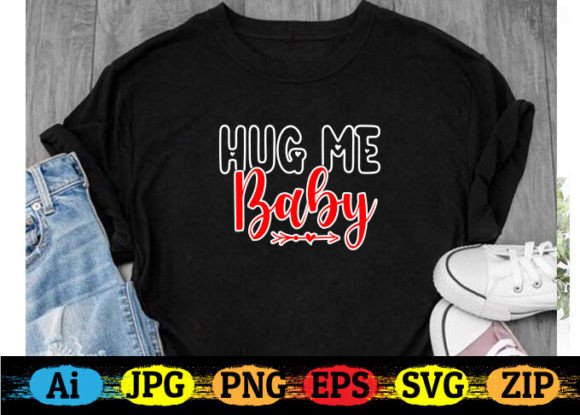
Hug Me Baby Graphics for T-Shirt Designs
As a graphic designer who’s built brand identities for handmade businesses, launched seasonal print-on-demand collections, and crafted packaging for boutique Etsy shops, I recently evaluated Hug Me Baby for a real client project: a soft-launch campaign for a new line of organic cotton babywear targeting mindful parents and local boutiques. My goal wasn’t just to assess cuteness—it was to determine whether Hug Me Baby functions as a reliable, versatile, and commercially sound graphic design asset across touchpoints.
First Impression: Warmth with Intentional Simplicity
Opening the files, Hug Me Baby immediately lands with gentle visual weight—rounded forms, soft linework, and a balanced negative space that breathes without feeling empty. It’s not cartoonish or overly stylized; instead, it leans into modern illustration with subtle texture cues and intentional proportions. The mood is tender, inclusive, and quietly confident—not saccharine, not clinical. That nuance matters when designing for audiences who respond to authenticity over cliché.
Where It Shines in Real Client Work
Hug Me Baby excels where emotional resonance meets functional flexibility. For our babywear launch, it anchored product mockups on Instagram posts and Pinterest pins—scaling cleanly from 100×100px profile badges to full-bleed hero banners. Its clean vector foundation (AI, EPS, SVG) allowed seamless integration into Canva templates for email headers and digital ads, while the high-res transparent PNG (4500×5400 at 300 dpi) delivered crisp results on tote bags, hang tags, and printed lookbook spreads.
- T-shirt design: Works beautifully as a front-chest motif or oversized back graphic—especially on light heather grey or oatmeal fabrics where its warmth reads clearly.
- Packaging design: Used as a subtle watermark on tissue paper and as a foil-stamped accent on kraft gift boxes—its rounded contours softened sharp edges without competing with typography.
- Social media graphics: Paired with sans serif body copy (Inter, Poppins), it elevated carousel slides and Reel thumbnails without overwhelming messaging.
- Cricut project & printable design: The editable SVG imported flawlessly into Design Space; we cut it from vinyl for nursery wall decals and scaled it for 8×10” framed prints sold as add-ons.
- Brand identity support: Though not a logo itself, it served as a key brand illustration—reinforcing voice across website banners, blog headers, and editorial design elements in the client’s newsletter.
Where Caution Is Required
Hug Me Baby isn’t universally deployable—and that’s a strength, not a flaw. Its expressive curves and moderate detail demand breathing room. Avoid using it in:
- Small-scale applications like favicon icons or app store badges—fine details blur below 60px height.
- Crowded layouts with dense text or competing patterns—its emotional tone gets lost without contrast.
- Minimalist corporate branding (e.g., law firms, fintech startups)—its warmth clashes with ultra-clean, monochrome hierarchies.
- Low-contrast backgrounds (e.g., pale yellow on cream)—test transparency rigorously, especially if layering over textured substrates.
Design Judgment Notes You Can’t Skip
Before clearing Hug Me Baby for client use, I ran these practical checks:
- Test in black and white: Confirmed legibility and tonal balance—no hidden midtone mush.
- Preview on both light and dark backgrounds: The transparent PNG holds up, but subtle shadow layers require manual adjustment on darks.
- Scale it down to 24px and up to 2400px: Vector files stayed crisp; JPG retained fidelity only above 300px width.
- Drop it onto real mockups: Tested on t-shirt, mug, and sticker templates—no edge halos or anti-aliasing artifacts.
- Print a physical proof: Verified color accuracy and registration on uncoated stock—no ink bleed or loss of fine contour definition.
- Inspect font pairings: It harmonizes with rounded sans serifs (Nunito, Quicksand), gentle scripts (Dancing Script), and friendly display fonts (Bellefair)—but fights against rigid serifs (Cormorant Garamond) or geometric extremes (Montserrat Black).
- Confirm commercial license: Verified unrestricted usage for client-facing deliverables—including resale on print-on-demand platforms and inclusion in digital product bundles.
Why This Graphic Design Asset Earns Repeat Use
Hug Me Baby bridges creative design and commercial utility. It’s not just clipart—it’s a thoughtfully constructed illustration with consistent stroke weight, intentional spacing, and scalable clarity. For small business branding, it adds emotional intelligence to marketing visuals without sacrificing polish. For digital sellers, its multi-format delivery means one purchase supports SVG-based Cricut projects, PNG-based social media graphics, AI-based brand extensions, and EPS-based sublimation design—all under a single commercial license.
In editorial design or web design contexts, it serves as a visual anchor that invites pause and connection—critical for audience engagement in saturated feeds. And because it avoids trend-driven exaggeration (no exaggerated eyes, no forced whimsy), it ages well within brand systems. That longevity makes it a smart investment for Etsy product listings, seasonal campaigns, or evergreen printable designs aimed at parenting communities.
A Final Note on Visual Trust
What separates Hug Me Baby from generic stock is its quiet confidence in restraint. It doesn’t shout—it welcomes. In a landscape crowded with overdesigned, algorithm-optimized graphics, that sincerity builds visual trust. When your client’s audience sees it on a onesie tag or a blog banner, they don’t just register an image—they feel seen. That’s not decoration. That’s strategic design work.